Saturday, May 9, 2026

MUTANANNY Post Mortem


This is one of those posts that no one really plans to make. I'm going to discuss two points of failure: first the crowdfund and then the game itself. If you're only here for design noodling, skip to the last section. Also, and listen to me as hard as you can: I am sharing lessons learned, not looking for more advice on how to "fix" anything.

MUTANANNY is a post-apocalyptic game loosely based off a more freeform campaign I ran for my friends back in high school and undergrad. The setting premise is that humanity destroyed the planet, mostly via global warming and pollution, then all the rich folks rocketed off to sleep it out on the moon. Your characters are mutants, twisted remnants of humanity who survived by constant physical adaptation.

Mutants contend with the day to day pressures of life in a homely garbage dump commune, the deadly swamps and marshes of post-apocalyptic Delmarva, monstrous Mutants (Snallygasters) who lost their minds, pumped up demolition derbies, and eventually the threat of high-tech human settlers returning from the moon. It used a variant of the METTLE system, not too far from the unnamed demi-dice pool system I used with the old group.

Eventually I answered a call from Gamefound for participants in a sort of group crowdfunding campaign. I bought some great cover art from a local artist who had a style I liked. My submission was quickly accepted and it was off to the races. Keep in mind I have never done crowdfunding before, so the idea of joining a bunch of other designers all in the harrowing journey together was appealing.

A unique and vibrant setting, a long history of playtesting, and a supportive group crowdfunding campaign! What could go wrong?

Crowdfunding Point 1: First Past the Post


Gamefound was nice enough, a little more convoluted to set up than my earlier drafts with kickstarter. They gave some good seminars but I couldn't attend most because they were scheduled during my working hours. I don't have a lot of criticisms of Gamefound specifically. The guy managing the RPG party was helpful, and things did eventually get off the ground.

What rankled me was a feature of the group project listing where the best performing campaign was always at the top. Now you may think "well of course they are going to want to feature their best performing campaign prominently." You're right, but you also have to realize this is a positive feedback loop. I realized this when I submitted early for one phase and for a brief moment my game was at the top! And it did well! People were pledging, commenting, subscribing... then the other games flooded in and bumped my game down. Everything sucked again.

So this got me thinking. When you submit as part of a group, your efforts publicizing it end up mostly supporting the top entries. If you are at the bottom you are just feeding them views. I think this is a really important point to consider when joining a group crowdfund project.

On the positive side, don't be afraid to put in high pledge levels. I had a few "whales" who were willing to plop down good money for tiers offering things like adding their own OC mutants or dumps. Just... not enough of them as it turns out. 

Crowdfunding Point 2: Friends in High Places

My prelaunch campaign was where I first realized I was in trouble. I wasn't the actual lowest on the ranking but I was close. I did everything I was advised to do: Gamefound ads, independent Facebook ads, Bluesky promotions, even Reddit ads. I had a video with music. I took feedback from an editor, drew some of my own spot art, implemented survey feedback, reached out to gamers I knew. I took all sorts of advice. Please do not take this as an opportunity to give me more.

Here's a bit of gained experience: Facebook ads get plenty of people who like and share, but never visit the link! Bots maybe? Reddit ads are absolutely worthless, like dumping water in the desert.

But my underlying problem is I don't really know a lot of people.

Most of the folks I like and talk with are from OSR circles. Unfortunately, this means MUTANANNY was one of those filthy "trad" games they only look at down their noses. I had a scant 150 or so followers on Bluesky and only a few even requoted. None said anything about it. By contrast, a few of the other RPG party members were apparently in tight with indy darlings, effusive with oddly vague praise about their projects. 

Long story short the crowdfund failed.

Funniest thing was after it failed I had people contact me saying the game looked really cool and asking when the campaign started. Baffling.

Game Design: Everyone is Special, so No One Is


Of course I could have ignored the crowdfund failure and self published the usual ways. This is where the second problem comes in; a conflict in how Mutations work.

At one point I thought it would be fun to try out the idea of Mutations not as stable traits but as on-the-fly transformations. I was bored with the permanent mutations featured in other games, and had bad experiences with players becoming obsessed with mutation builds instead of the actual game.

I arrived at a compromise. Mutants would have a stable cosmetic oddity that made them unique, but could change their mechanical Mutations to suit the situation. For example, a Mutant with a rat-like appearance could grow gnawing teeth to bite through their bonds or enlarge their ears to better hear foes approach. One with a loose floppy skin could wriggle their way out of a wrestling hold or bunch up their folds as armor, etc.

There were no real limits to what Mutations could be justified, their appearance just gave a hint to how it manifests. It was exactly what the setting required, and I figured why not try it out.

The end result of this is that every time they needed to throw the dice, players would start suggesting Mutations to overcome it. You'd think this would be perfect, exactly what they are supposed to do. The problem was it was too perfect and it started to feel... samey after a while. The Mutations became a swiss-army knife for every situation. To be fair the same thing happens in fantasy games with very flexible magic systems like Genesys, or high level D&D or Mage where magic becomes a first resort.

I might go back to it if I can think of a good way to handle mutations that are not exactly stable like other games, but also not as fluid as this iteration. 

On the GM side, this also made describing the inhabitants of a Dump or a Booglarizer raiding party burdensome. Every single one would have some combination of physical weirdness and whatever mutations they were currently manifesting. Great for PCs, overwhelming for NPCs.

Bedtime for Bonzo 

I did enjoy writing this game and I think there are a lot of things about it that are superb. The setting is fun and a departure from most post-apocalyptics, and the vehicle races were a hoot to play. METTLE Core worked very smoothly as a ruleset, and a lot of things are going to get carried into future games. 

But the truth is, it was a failure and this post is what I learned from it.

If you feel morbid, you can also take a look at Mutananny on Itch or Drivethru, or gaze at the remains of my gamefound campaign page. 

Sunday, September 21, 2025

Drone Warfare in TTRPGs

I'm surprised with how relevant and devastating drone warfare is recently, that we haven't seen more tabletop RPGs doing models or even fantasy abstractions of it. The drone is an advancement beyond both soldiers and artillery that battlefields are still adapting to.

The Horror 

To even a casual viewer, the drone is horrifying on a battlefield. Soldiers often resort to staying stock-still - not because that is any escape, but probably because there is really nothing they can do. I am not sure how this compares to the awfulness of small arms combat or artillery, but it sure seems like a new and strange man-made horror and you have to question whether you want it in your games in the first place. It's a bit too real, too hopeless. What do you do if your players are decimated by exploding suicidal flying machines? What if your players just routinely barrage their foes with fleets of indefatigable airborne suicide bombers from afar? Where is the challenge either way?
 
Watch the video of many last moments at your discretion:
 
 
That said, there are games that already cater to this terrifying spectacle, and ways to adapt them to better portray this.

Sci-Fi RPG Instances 

  • Shadowrun: Drones have been present ever since the first edition way back in the 80s, when the modern drones we see today were but a glimmer in the eye of defense contractors. This version called them "remotes" which had surveillance and combat functions, depending on the version. I played that version and practically no one ever took a drone. A later version of Shadowrun featured a rigger with drones as a quickstart character. I do not know if this was a particularly powerful loadout, someone more familiar with modern shadowrun would have to tell me.
  • Eclipse Phase: In the games we played there were a lot of drones, but mercifully only as enemy surveillance. I do not know how we would have handled an onslaught of explosive drones. Like shadowrun, it certainly could happen in this setting, probably complicated - morally and effectively - by how sentient you make the drone.

Fantasy Metaphor

Imagine a magic-user who could summon drones of the modern age with a wave of their hand. Cue groans from the table and rolling of eyes. The gun-mage is a cute meme but grating to players who came for fantasy, moreso the drone mage. When we play fantasy we abstract the terrors of the modern world into lightly disguised magical contrivances. Look for things that are disposable, controllable, long-ranged, and lethal.
  • Familiars: these can go as far as they like, and have a telepathic connection to their master. Magic-users often use their beloved airborne familiars for reconnaissance but not as suicide bombs, mercifully. Your gaming group may differ but as awful as some of mine have been they never did that.
  • Summons: disappear after the spell ends and can travel long distances before it does, and can be quite lethal. They fit the bill for the most part but are not directly controllable once they are out of sight.
 An ideal fantasy drone would be disposable and lethal like a summon but directly linked to the owner's senses like a familiar. I am not sure if any such thing exists in the game, could be wrong.
 
The Wonderful Wizard of Oz | The Drone Light Show | Durham - Yuup
Drone show of a witch or wizard, Durham festival 
 

Providing a Modicum of Challenge

There must be some countermeasure. Aside from directly shooting at them, troops on either side resort to things like netting to tangle rotors, cages to distance equipment from the explosion, and electromagnetic devices to deactivate them. These are direct translations in sci-fi games but fantasy games are limited to dispels and jury-rigged nets and cages. One things a fantasy game with endemic drone enemies could do is create a class or school of magic that is dedicated to magical drone warfare, both offense and defense. Would it be interesting to play? Who knows.

Saturday, August 2, 2025

Detect Tarps

Picture Unrelated


After my last game players came to me to complain about the difficulty of the tarps they encountered. Oddly, their main problem was not the lethality, it was how they were "anachronistic" and didn't make sense in a fantasy game. Some even said they were unengaging and pointless, a vicious blow to any DM's ego. In the spirit of OSR, I decided to give everyone else a lecture instead of addressing my own flaws.

So here are the best ways to run tarps in your game: 

Cleverly Camouflaged Tarps

I'm told there is a tarp in this image
 

Thieves already have a chance to detect tarps, but we all know it is pretty low. I thought to really hide the tarps in one room and make them very difficult to find, penalizing the percentage chance. When they failed, I announced gleefully that they ran straight into a concealed tarp, but none of the players seemed excited at all.
 

Provocative Open Tarps


If players find hidden tarps unengaging, the obvious solution  is not to hide them. Put them right out in the open and let the players try to ignore them. Just try it! This is obviously a much better solution as my players interacted with it right away by walking around it.

Role Playing Tarp


Another strategy is to make your tarp appealing to players who like to roleplay everything to the hilt. As pretty much every recent race revision shows, the best way to do this is to add a usable hole to it. Here, the tarp has a gaping hole ready for your most ardent "bard" type player.

Also, a tarp with a hole in it and an NPC are basically the same thing, topologically. Science! 

Incentives

As every good game designer knows, the solution to bad design is to patch it up with incentives. The worse it is, the more you have to bribe or manipulate players to play it. 

I am trying out the idea of Tarp Points, or TP. These are awarded for interacting with and commenting on tarps. The real kicker is they give powerful tarp-related bonuses randomized with a tarp related tarot deck or TARPTAROT (which I will sell). It should be impossible for the party to ignore my lovingly designed tarps, because that would be a sub-optimal play strategy.

 I have also cleverly integrated it with OSR principles by calling these incentives a ruling. I got this idea from a blog post called "Against Incentive" which I shall read one day.

So that was my solution to this common problem. Hope this helps! 

Thursday, June 26, 2025

Review of Bakto's Terrifying Cuisine

What It Is

Your party finds themselves in the kitchen dungeon of Bakto, a picky eater for a demon. Satisfy his culinary demands or die trying. This is a small hardback book written for The Vanilla Game or OSRs, and easily adapted for anything else. Here is one of the monster stats. It should look very familiar. If you can't work with this, I don't know what to tell you:


Bakto's was written by Giuliano Roverato, Gustavo Nassar, and Rodrigo Melchior, with art by Sam Mameli. Lovingly inspired by Iron Chef and other frantic cooking shows; the party scours the dungeon for ingredients, encountering wild situations, engaging NPCs, deadly foes, and powerful magic items all the way. I found it has a lot of replay value as the ingredient randomization and time limit make it different every time you run it.

Get it at Spear Witch, itch.io, and DrivethruRPG. As far as I can tell, the only way to get the physical book is through Spear Witch, so do yourself a favor and get it there. If you do itch.io you get a coupon for the physical book, I gather. That's kind of second-best stuff though, and you are better than that.

What It Isn't

One misconception I had going in is that this was a scavenger hunt. Turns out, Bakto was apparently not prancing around the dungeon like a demonic Easter bunny beforehand, hiding just the right things for your players to find. Maybe they were never supposed to succeed. Try to concretely find the abstract flavors he demands like "Drama" or "Nuclear" and you will fail. As you should, fool.

To survive, the party has to shoehorn dungeon debris and monster giblets into some passable mockery of bespoke cuisine, and do their damnedest to cater to his flavors. This is how my game went - my players grabbed what they could and somehow made it work. Barely!

The Time Limit

There is a time limit, which means the party can only explore some of the rooms. Think of the mad shopping cart dash through the grocery store in cooking contests - they can't get to every aisle, can't get everything they wanted. Probably don't know where to find them in the first place! It is small, but every party you run through it could viably experience a different dungeon. You and your party can be surprised even if they already ran this, and the latter part of the book gives some solid ideas for changing things up on repeat runs: teams, secret ingredients, etc.

The Tone

Due to the art and theme, you can forgive people for thinking this is light in tone. It's definitely gonzo, but it is a very deadly adventure with great risks and rewards. Think of the lore lurking behind the bright palette of Adventure Time or the deceptive depth of most Troika! adventures. There are rooms that defy the visual tone, my favorite of which can easily lead to transforming and stranding the party, or worse.

Just some light-hearted whimsy, as long as you don't look too close.

This leads into one of my only concerns about this adventure; curiosity can really kill the cat here. Several rooms I am sure I would lose character after character to as a player. If you run this game you will need to calibrate how many cues and chances you give the party to notice something is amiss. Read it beforehand and you will know which rooms I mean. Definitely memorable though, and not as light-hearted as the tone suggests.

My Bakto Session


My Bakto was transparently based on Aku from Samurai Jack. The author says he was based off the 1st edition AD&D DMG cover, and I can see that. Once you picture Aku in your head though it is hard to get that impression out. I doubt I am the only one. I had him really brag about the rubedite cookware he had, pulling from the real life memory of one of my foodie friends always boasting about his goddamn copper pans.
 
Brothers from another mother (maybe, I don't want to think about that.)

My party found out about the allergy from an NPC but were deceived about its nature. This lead to a great moment where they expected Bakto to die upon eating their dish, were baffled when he didn't, started to feel horror that they now had to go through with the contest they thought they would fail, then did not, barely.
 
They only got into actual combat once, on a random encounter. I can see less fortunate parties finding themselves in great danger, especially at the low levels suggested.
 
It was a fantastic game overall, everyone loved it and I begrudgingly admit they may have enjoyed it more than the foray into B4: The Lost City they were amidst (I run B4 a lot). 
 
I now keep this game in my bag, not on my shelf. Loaded and ready for the slightest window of opportunity to play it.
 

How to Enjoy

I ran this as a one-shot and feel like this is its best use. Spreading it out over more than one session might squander the beautiful anxiety from the time limit. As a one-shot, it would also make a great palate cleanser when switching game masters or settings. The best thing I did was to make sure the party would occasionally hear Bakto's booming voice announcing the dread passage of time, describing exactly how he would cook and eat each of them, etc. Normal stuff.

End Note: Author's Discussion 

I generally refuse to read anything about the author explaining their game before I play it, and you should too. If you already played it or just don't care what I think you can read the author's story about its development here.


Saturday, June 21, 2025

Hit Points as Doom Timer


I'm going to poop out what is sure to be a wildly unpopular idea. We all know the ancient discourse about how hit points (HP) in D&D alternate between physical or "meat" points and luck/fate.

In this hack we focus on HP purely as fate or luck, a timer set between the character and their ultimate doom. We achieve this by simply disallowing healing. Every hit is either just flesh wounds or near misses until the last one. Healing, natural or otherwise, is purely a narrative conceit. Levels would still add HP if anyone manages to eke out a level under this method. It would in fact be the only way.

The draw to this method is that getting to the end of your HP means you are probably nearing the end of your story too, so make it count. Does only the player know, or is the character also aware of their upcoming demise?

I think you will find that the longer you play, the more you will realize that the death of a character is often the best part of their story. Too many players are robbed of the best experience in role-playing by intrusive systems that prolong their lifespans unnaturally. Do you really want to hear about that party of super heroes knocking God on its ass, or the scrappy adventurer who tried to grapple a Grell under the light of a dropped and guttering torch? Look deep in your heart, you know the truth.

Naturally this makes Clerics and healing potions useless. C'est la vie. Leave them out, or make healing potions exceptionally rare. 

Enjoy, if you dare. 

Monday, September 9, 2024

The Vacation Game

A brief play report of my kid's dungeon, made without any of my input and played during a beach vacation.


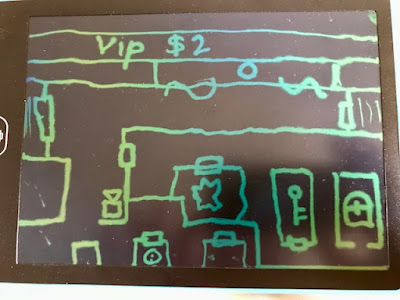
If you're dead tired of dads talking about their 7-year old wunderkind role-players, turn back now. You're looking at two of those little drawing tablets; above is the map, below is health and inventory.
 
There's a bit of "video game brain" polluting the free kriegspiel nature of this. For the inventory he drew Zelda hearts and filled them in when I took damage. We had a hard time when healing, because he would just cross off the row and draw them again. The long bar is magic, which he kind of gave up on tracking because it was annoying, as MP systems tend to be.
 
The top row shows a monster and its two minions. I had to guess which key and door would open the way to it. If I guessed wrong it was instant death and I respawned. There was actually a pause the first time I died, because he wasn't sure what to do if I screwed up. Then the respawn, which felt like a bit of a plot armor thing. So, more video game brain but funny.
 
Above is part of stage 2 that I got a picture of. It's more sophisticated. There are hallways, doors, chests, secret doors (the supine Ss), etc. I managed not to die here and got a stick, which I could use with my dagger to make a spear. I did, and killed the thing in the central room.

There is a VIP $2 at the top. He wanted me to give him two dollars and I would get a good item. I passed, he was disappointed.


A long hallway with some prison cells. I searched them and there was nothing in them, which made me proud. People, there doesn't have to always be something there.


Adjoining hallway, two slimes at the far right, a mystery potion in the room below (two triangles on top of each other)


The maze before the boss monster room above. There is a key in the maze that opens the chest, which had a staff I needed to defeat the monster. The staff was fueled by the potions I found - a nice touch as they were frequent finds. I tried to talk to the boss and see if we couldn't find some common ground, but it just attacked. The strategy was to use the staff to zap it down out of the air then hit it when it was on the ground. Neither by themselves worked. Again, very Zelda but fun for a TTRPG.

Went out for night kites and pizza on the boardwalk after.


Saturday, July 27, 2024

Grid Cells and Hex Maps


Image by Ermal Tahiri from Pixabay

In RPGs, dungeon maps are usually square grids and outdoor maps are usually in hexes. There are certainly good reasons for it. Dungeons and other artificial structures, are usually built square. Outdoors, the directional flexibility of the hex make it ideal for plotting out chunks of travel. Some of it is most certainly tradition from early Avalon Hill games and the Outdoor Survival supplement from 70s D&D.

So you have two main tesselations for mapping in RPGs, competing away in your game books.

Does anyone ask what the brain thinks? Our poor ignored little brains?

Grid Cells

For that, we look to neuroscience. A while back, a group of researchers (Hafting et al, 2005) filmed a rat with an electrode in its entorhinal cortex - an area of the brain important for navigation and closely connected to the memory-laden hippocampus.


In the video below, a dot is added at the position of the rat every time the cell spikes. As the rat explores, more and more firings are recorded, finally converging into a roughly hexagonal grid. You have to squint a bit to see it, but it is there towards the end. 


Spoiler:


You'll note this fits a hex grid well, if a bit distorted. It doesn't fit squares all that well unless you tilt them 45 degrees, and even then it is off.

Is this proof that the hex is superior for mapping, because it already has a presentation in the navigation system of the brain? Probably not. But, it's something to think about.

Tuesday, July 9, 2024

Initiative and the Next in Line effect


Image by Cdd20 from Pixabay

I'm sure you have noticed this over and over: you call on a player and they have no idea what the current situation is. They need a refresher before they act, everyone groans and fills them in on what just happened while they were zoned out. The player insists they were keeping up but just lost track for a minute. It won't happen again (it happens again). Maybe it happens to you as a player, and you don't know why.

Everything that took place prior to their precious turn is just... blank. Why?

  • Is this just a failure to pay attention? 
  • Are they only interested in themselves? 
  • Is your game boring?

Or is there something more basic going on?

Background

A ways back, some researchers (Brenner, 1973) did an experiment on the long-observed phenomenon of how being next in line to perform can effect attention. To do this, they had participants sit down in a square, with each participant taking a turn to read a word aloud from a card. Turns out the participants had more trouble remembering the words they heard just before and after their turn.

If figures help for you, see below. It is a little crowded, but the dotted lines are the ones we are concerned with. The peak in the middle is their ability to recall their own word (of course). Notice that the lines on the left sink just prior and rise just after - showing that they remember less before and after their turn.


The article, and a decent amount of later research has attempted to fill out the explanation, including failure to convert the recent words from short term memory to long term memory, performance demands (which they show evidence to discount), and helpful sensory cues that occur during their own performance to explain the peak. 

It is all however, a little unsatisfying when applying this to role-playing games. It may be our closeness to the subject, but the the intuitive gamer explanation is that there is a simple competition for attention between preparing for your turn and noticing what the player before you did on theirs. I believe this remains to be tested in the context of RPGs - perhaps a job for an aspiring games researcher.

Solutions 

As interesting as it may be from a scientific perspective, it is a goddamn nuisance during a game. The problem clearly relies on using an Initiative system where the turn order is known before hand, as in nearly all D&D. If the players are less certain of when their turn takes place, this zoning-out effect may be avoided. Fortunately, there are many such ways to run Initiative:

  • Volleyball Initiative: turns are passed from the actor to the actee, with strategies like bumps and spikes. I mention this first because I made it, it is awesome in play, and it still gets ignored by people who make big, supposedly definitive lists of initiative types.
  • Troika/Bag Initiative: turns are decided by pulling rocks or chits out of a bag.
  • Popcorn/Balsera/Elective Initiative: turns are passed by the actor.
  • Side Initiative: turns are decided by the side holding Initiative.
  • No/Spotlight Initiative: turns are decided by GM fiat.

 ... etc.

Conclusion

It's natural for players to space out before their turn. If this is unbearable, consider switching to one of the many types of Initiative that mix things up enough that they don't know exactly when their turn comes up. Will it work? Who knows.


Saturday, June 15, 2024

D66 Overlap Tables


The D66 table made it possible for games that only use six-sided dice to stay true to themselves when they needed a random pick list. The first incidence was almost certainly Traveller, but I associate it most strongly with Troika these days.

Briefly, roll a d6 for the ones place, another for the tens place, and consult a table of 36 options. This is more than enough for most random tables, and you can reduce the options by lumping results together (i.e. 1,1 - 1,2) and expand upon it by adding dice (D666, etc.) or nesting results. See this page for some common variants.

Birth of D66 Overlap

Anyway, I like them quite a bit. I was just writing one up for post-apocalyptic weather in ROACH (working title), when I got an idea. I was thinking of using the entire D66 table for fall and spring, rolling twice and taking the highest for summer, and the lowest for winter. It struck me how awkward it is to roll a D66 twice, and how it was a bit of a stretch to still get hot weather in winter and vice-versa, even if it was less likely. That's two counts against it.

So what if instead I made the D66 table partially exclusive - fall and spring would still read the D66 and span the entire table normally, but summer would read the highest die first, and winter would read the lowest first - reducing their possibilities. Except for doubles, this would split the table during summer and winter. This may be a bit weird to wrap your head around until you see it in action:

  • Doubles (11, 22, 33, 44, 55, 66): put all the results possible during winter and summer here. In this case I put all the gonzo apocalyptic weather here, as it did not feel overly seasonal.
  • Lows (12-16, 23-26, 34-36, 45-46, 56): put all the cold or wintery results here, plus a few of the warmer ones because the climate is a bit too warm, even winters can run a bit hot.
  • Highs (21, 31-32, 41-43, 51-54, 61-65): put all the hot or summery results here.

I like to split these up as above when designing the table, with three columns for the 6 common results, 15 lows, and 15 highs. I even made a spreadsheet that automatically sorts them into a regular D66 table format to keep things convenient. You can find it here if you want a template for your own uses.

For example, the weather table I was referring to above:

This was made by entering the list into a spreadsheet - the column on the left with entries stacked together for the low (blue), high (orange), and both (clear) lists is on the left. To the right, it restacks the types into a D66 list in regular order, you can see how it shuffles them for publication style.


(coloring added due to a good suggestion by "PolarFrosty" on the OSR discord)

I'm not too concerned with whether I was the first one to think of this. RPGs suffer from a lot of lost history. It is useful to me however, and I am damn well using it. If this sparks any ideas for any of you, feel free to comment below.


Sunday, May 5, 2024

Unified THACO Resolution


The 1st Edition AD&D Dungeon Master's Guide contains the seeds of a standard method to resolve actions. In the example adventure, a party member can try to catch a scroll case before it floats away. It's just a regular hit against AC 4. This has all the feel of an on-the-spot "ruling" enshrined by happenstance, but it may also hint at an underlying unified "check" mechanic in early D&D. These pages are clearly instructive, showing how to handle uncertain events out of combat. I will talk about how to develop this into a very organic OSR house rule later:

Page 96 (as a room description):

Page 99 (as a play-by-play of the same room):


They seem to have abandoned this subtlety by AD&D 2nd edition, the idea-space being filled up by roll-under ability score checks for things like non-weapon proficiencies. Pretend for a moment you do not want to follow down that road. Your OSR-type game might benefit from a unified mechanic, especially if it is basically invisible. It's so natural you can even just pretend it was an on-the-spot ruling.

The Unified Hit

This is just taking the hint from the DMG and sticking with to-hit against AC as a general unified "check." As this was only ever a hint, let us flesh it out a little. Gauge the AC of a task by considering how well armored it is: a normal task is like an unarmored target (AC 10), a very difficult one like a foe in full plate & shield (AC 0). If the task is easier maybe don't call for a roll, but you see where this is going. If you are using the roll-high variant in OSE instead of THACO, this is going to look just like a modern D&D skill check.

Undoubtedly, you are now raising your finger, opening your mouth, and closing your eyes, a well worn "well akshually..." on your lips. You've found a great and terrible flaw in this system: "But this means Fighters are better at things - even basic knowledge! Congratulations, you are very smart. Consider this though: Wizards are good at spells and such, but their weirdo brains are not wired for practical solutions. Half of their education is probably calling up Imps to do things for them, like fantasy ChatGPT. Clerics and Thieves are kind of average folk who specialize in their divine magic or criminal hobbies. It is the humble fighter who must deal with actual reality and live by their wits, such as they are. Plus, just let them have a thing. They need it.

Note that Fighters do not always have a definite advantage either, especially at low levels. For example, it is good to set the AC of athletic or stealth checks equal to the AC of the character performing them. As such, it is harder to sneak or jump around in armor. In the case of thieves, this ends up giving them a slight advantage over more heavily armored fighters despite a lower to-hit. Furthermore, Thief class abilities should kick in on a failed roll.

Modifiers

Adjustments like bonuses or penalties can come from a relevant Ability score and/or the situation. This can get weird with AD&D or earlier, as the bonuses are not standardized. Do the best you can, using the recommendations below as a guide:

  • Advanced D&D: For INT, use the Possible Number of Additional Languages, which is higher than the others but who cares. For WIS, use the Magical Attack Adjustment. For DEX use the Reaction/Attacking adjustment. For CON use the HP Adjustment. CHA is a little more complicated because it is all percentiles (way to go Gary); just use the tens place of the percentile as the modifier (i.e. -25% is a -2).
  • Basic D&D: For INT, use the number of added languages. For WIS, use the Saving Throw Adjustments. For DEX use the Missile Fire Adjustment. For CON use the HP Adjustment. CHA uses the Reaction Adjustment.

The Dread Spectre of Skills

A good half of you read this and immediately started working up a way to cobble together a skill system for D&D and AD&D. You're probably oozing with greasy little homebrew standbys like using a d12 instead of a d20 if unskilled, patching on advantage/disadvantage, using wizard/magic-user THACOs if unskilled, implementing the Turn Undead table somehow, working up a massive trad skill list...

...maybe cool down a little.

Instead, just leave it all be. If the character would be good at something, due to their background or whatever, change the outcomes instead of the check. Don't even have them roll if it is something they would know. This is completely intuitive and demands no changes to the game. It's already there.

Example

The important thing is that you can implement this without changing anything in the game. It's more of a ruling than a rule, as they love to say in these circles.

In game, it could look like this:

DM: Fleeing onto the docks, you see a small sailboat, bobbing in the waves.
Player: I jump in and sail off!
DM: Does your character have any experience with boats?
Player: no, desert tribesman.
DM: You're missing something important, but fairly obvious. Make a to-hit roll vs. AC 9, add your WIS save adjustment.
Player: a 7, I miss whatever it is.
DM: You start to paddle out but the rope pulls tight and you stop with a sickening jerk. The mob on the docks is gaining, your lead disappearing.
Player: Oh damn I forgot - I reach over and cut the rope!
DM: You paddle out just in time.

If the character had a nautical background of any sort, the DM would probably just skip the check and just remind them, or even better allow a Check to paddle out of the dock even quicker and raise sail like a champ. In any case, whether someone has a background in something rarely needs rigid definition. It should be obvious after playing the character for a while.

Feel free to chime in below with observations, experiences from those who have tried it this way before, etc.

Wednesday, March 20, 2024

METTLE Hybrid Dice Pool

There is a recent trend towards RPG designers leaving design notes in their actual game books. I have mostly avoided them in my work. If the reader cares they will find out soon enough through play, and if they do not it was probably unimportant. Perhaps the readers will make a video or write a blog post about the "unspoken design intent" or some such - why spoil their fun by explaining it before they do?

     In METTLE Core I had one lapse. Gaze upon this one shameless morsel of designer narcissism, from the Engine chapter:

Note: the average score of a single die is 1, making it easy to gauge chances of success. This also means you can directly contest single attributes, using one as the active check and the other as the passive difficulty.

     I like to think this was restrained, driven by the obvious necessity of explaining why I just didn't use a "normal" dice pool everyone is already familiar with. In this largely unread blog well outside of my similarly unread game books, I am less constrained by good taste and dignity.

     So let's dive deep into why I used a strange hybrid dice pool for METTLE!

Direct Contests

The biggest reason is that it allows you to directly Check a single Attribute against another, rolling one Attribute and using the other as the Difficulty. In METTLE they are equivalent! This may seem abstract but it really makes the design space much more flexible.

     The usual solution in other dice pool systems is opposed Checks or "Contests". Here both sides roll their die pool. This is also direct, but eats up time and patience for both the player and game master - especially if there are a lot of enemies or actions.

     Another typical solution is to set a defender's stat as the difficulty of a check, but with standard one die equals one success pools, the difficulty is too high! Most dice pool outcomes average out at about half of the pool or less. Other games that do this get around this with an indirect kludge: halve the defending pool or add an Attribute or Skill to the attacking pool. This pumps the number of dice up pretty high and the effect of the doubled or halved pool will scale oddly as numbers increase.

Margins/Edge

Most dice pool systems count the number of successes over the difficulty as a margin-of-success. In METTLE there is no subtraction, you just count your Edge (4-6 faces). Edge dice would normally just be failures (or worse, "scoundrels") in other dice pool systems, but here every die that falls is important. You want to roll 1-3s for a good Score, but you also want 4-6s for Edge!

Probabilities

The central conceit here is that the average score on any die is 1, ranging from 0 to 3. You can check this yourself: adding the Scoring faces and dividing by the total faces gives us:

 (1+2+3) / 6 = 1

     It's a pretty minor feat in Anydice to check this: 

Mean/average is always the same as the number of dice, deviation increases reliably with dice, and the maximum is always 3x the pool. Really a lot of desirable behavior. The figure below has the percentage chances in the vertical (y) axis and the range of scores on the horizontal (x) axis, with each line being a different number of dice in the pool. It gives the % chances of scoring at least that amount, so zero is always 100%, and so on:

Origins

This traces back pretty far to posts (2015 and 2016) on RPG.net back when you were allowed to argue about game mechanics on the game design section. Believe it or not, what is now a silent desert was once a thriving little ecosystem of horrible nerds.

They did bring up a fair criticism that the modal value of the dice was a little odd at lower dice pools (<5), but this is also a reason I avoid using die penalties and raise Difficulty instead.

This was probably in RISUS a lot earlier, as "Demi-dice" for static cliches. For the timeline, it is hard to work out when this was an option in RISUS however. I am going to assume it is the first publicized incidence, until anyone shows otherwise.

Conclusion

That's all for now. I'm probably not posting this widely because it is very niche as far as interest.

Pipe up if you have any comments. You know what to do.


Sunday, March 17, 2024

D&D B-Series Pregen Ability Scores

I have been ruminating about old school D&D Ability Scores, and whether they meant all that much. So I decided to run the numbers. I entered 146 pregenerated character stat lines found in the B series of adventure modules into a spreadsheet and imported them into R Studio. Pooped out some descriptives and ridgeline plots, and here is the result. It's more of a descriptive analysis than an inferential one - I do plenty of the latter in my day job.
 
Keep in mind that I can only look at what the designers chose for their Basic modules. I was active in the 80s and the actual state of play was all over the place. Overpowered characters with ludicrously high scores were ever-present. I propose that the more restrained arrays in the modules are reflective of designer intent, whatever you believe that is worth.

What I wanted to find out:
  • How did the carefully pregenerated module characters stack up to 3d6 down the line?
  • What would an average representative of a Basic D&D Class look like score-wise?

Overall Ability Scores by Class

Ideally, Character creation in Basic D&D involves rolling up a set of six Ability scores from 3-18 each, then seeing what sort of Class they qualify for. A Magic-user needs an INT higher than 9, etc. This first plot is the average Ability score for a given class, lumped together. This gives a broad overview of what the actual average score is and which classes tend to get assigned better rolls. At this point there were no Ability score bonuses for Races, so everything is conveniently 3-18.
 
To show this I use ridgeline plots, a kind of smoothed aesthetically-pleasing histogram. I have added a dotted vertical line in the middle of each to show the mean (10.5) for a 3d6 roll. The color also shifts with the score - lower scores are bluish, higher scores reddish.


Well, would you look at that - an awfully suspicious trend towards better-than-average! Is this a selection bias to ensure that players get decent pregens, or a result of Moldvay's option to reroll "hopeless" characters? 
 
The world may never know. 
 
The average module pregen actually sits at 11.4, or roughly 11-12. This is a slight boost over the 10-11 expected with purist 3d6 rolls. Sorry, but I can't be bothered to check for statistical significance, even with R open as I am writing. Maybe later.

Other take-aways:
  • Clerics and Thieves seem to get assigned the worst overall rolls.
  • Elves and Dwarves seem to get assigned the best overall rolls. 
  • Magic-users and Dwarves seem to occupy more of the very high results, shown by the taller and longer red tails.
  • Halflings have a weird small bump in the low/blue end, perhaps a population of crappy Halflings that throw their otherwise good curve off.
  • Fighters are very consistent, almost a normal curve for their rolls.

Classes Breakdown

What follows is a little different: the average score for each individual ability, separated by Class. This shows what specific ability scores are favored or disfavored when considering a Class. Sometimes, the histogram splits into two peaks, and it is debatable what that means.
 
To preface some things I will mention later, Basic D&D also had a thing called a Prime Requisite, which is an Ability Score or two that the designers deemed important for that Class. If they were good (13+) you would get a bonus to earned XP. If they were bad, you could get a hefty penalty to XP. I believe these explain most of the patterns you see below.
 
(Images by Terry Dykstra, from the Rules Cyclopedia)


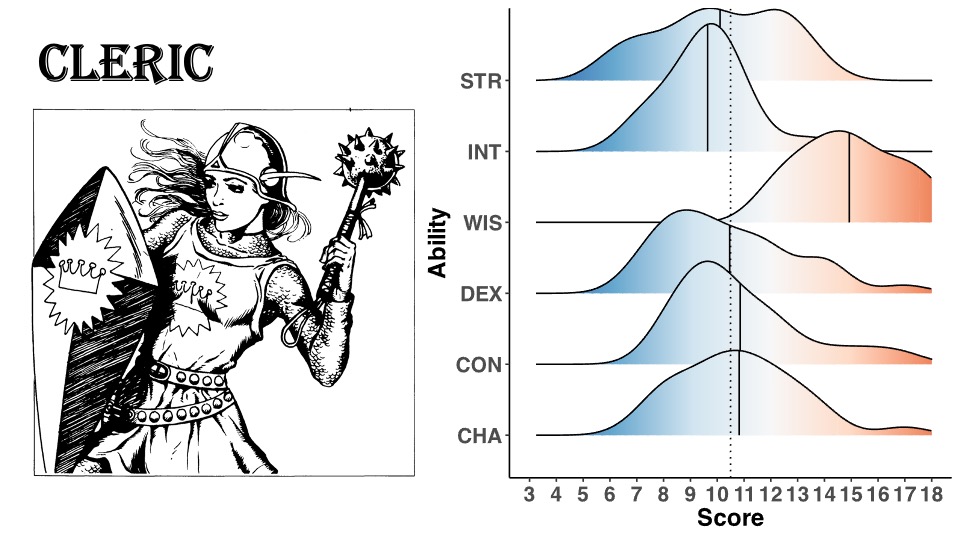
Middling folks relying on their connection to a (usually) unspecified deity! Rolled arrays with a high WIS and little else going for them seem to become Clerics. WIS is entirely for the Prime Requisite XP bonus I think. It only enhances magic saves, which everyone else needs just as much. Clerics tend toward lower INT, probably because religion is silly. To be fair though, the power and versatility of their Class more than makes up for the quality of its members.

The module authors are really giving some good scores to Dwarves. STR and CON are reliably huge. INT, CHA, and DEX tend to suffer, but the two peaks suggest two different camps on whether their WIS and CHA should be high or low. The stereotypes weren't quite set in stone then perhaps.
 
As a special note, see the low blue tail on CON that shouldn't be there. This is partly the ridgeline smoothing extending the curve, but also some mistaken roll assignments. Dwarves have a minimum CON of 9, but tell that to the module authors. This happens elsewhere too (see Halflings).

The best scores reliably go to Jacked-Genius Elves. If you get an array that could make one, I guess you just go for for it. The peaks might show a little division on whether their CON and WIS scores should be low or high.

Halflings were oddly beefy for their size, which no one seemed to think twice about. Despite basically being Fighters, they had minimums and prime requisites that meant the best scores would often go to them. This was probably intended to keep them rare, like elves, but also just made most adventuring exemplars of their race pretty outstanding.


As Ash Williams might say: "Hit first, Think never." Good physical scores and low mental ones. There is a broader range of CHA - a high one makes sense if you want them to be a good leader at domain level, a low one if they are just a rough-neckin' thug.


Scraggly nerds, but they are investments for later godliness, so you want to give them a solid set of scores. A high INT and low STR is obvious, everything else is a nudge above average. Note that like the Cleric, their prime requisite of INT is only good for the XP Bonus.

Light-fingered and charming, with little else going for them. Most of the time they will be relying on their special abilities rather than their Scores anyway - and even their godly DEX has no effect on these in Basic.

Summary of Breakdowns

So if you just "need a guy" real quick, you won't be too bad off using one of these arrays:


A Word on Prime Requisites

The idea of high Ability Scores primarily just giving an XP bonus to certain Classes may seem strange to a modern player. This is often its largest benefit in B/X. For example, the benefit of having a higher INT is mostly that your Magic-user rises through their levels a bit more quickly. It has no direct effect on their number of spells or spells known. It only has an impact on their magic in a roundabout way, unlike later editions.

A Word on Minimums

Most Classes also had minimum scores, but those probably had less influence. There are even errors there, for example some Halfling pregens had CON scores below 9! I have left similar genuine mistakes in the database uncorrected, only correcting obvious typos like a Fighter with a CON of 1. In that case I changed it to an 11 - "1" is a common typo for a repeating number like 11 and close to the average anyway.

Conclusion

I don't think anyone came away from this with any surprises. Pregenerated characters had slightly higher Ability Scores than 3d6 down-the-line would imply, Ability Scores tended to reflect the Prime Requisite(s) of the Class, Clerics blow, and Elves rule. I had fun doing it though and hope you got something out of it too, even if it was just confirming your suspicions.

Comment below, especially if there is something else you want to look at.

MUTANANNY Post Mortem

  This is one of those posts that no one really plans to make. I'm going to discuss two points of failure: first the crowdfund and then ...