Saturday, June 15, 2024

D66 Overlap Tables


The D66 table made it possible for games that only use six-sided dice to stay true to themselves when they needed a random pick list. The first incidence was almost certainly Traveller, but I associate it most strongly with Troika these days.

Briefly, roll a d6 for the ones place, another for the tens place, and consult a table of 36 options. This is more than enough for most random tables, and you can reduce the options by lumping results together (i.e. 1,1 - 1,2) and expand upon it by adding dice (D666, etc.) or nesting results. See this page for some common variants.

Birth of D66 Overlap

Anyway, I like them quite a bit. I was just writing one up for post-apocalyptic weather in ROACH (working title), when I got an idea. I was thinking of using the entire D66 table for fall and spring, rolling twice and taking the highest for summer, and the lowest for winter. It struck me how awkward it is to roll a D66 twice, and how it was a bit of a stretch to still get hot weather in winter and vice-versa, even if it was less likely. That's two counts against it.

So what if instead I made the D66 table partially exclusive - fall and spring would still read the D66 and span the entire table normally, but summer would read the highest die first, and winter would read the lowest first - reducing their possibilities. Except for doubles, this would split the table during summer and winter. This may be a bit weird to wrap your head around until you see it in action:

  • Doubles (11, 22, 33, 44, 55, 66): put all the results possible during winter and summer here. In this case I put all the gonzo apocalyptic weather here, as it did not feel overly seasonal.
  • Lows (12-16, 23-26, 34-36, 45-46, 56): put all the cold or wintery results here, plus a few of the warmer ones because the climate is a bit too warm, even winters can run a bit hot.
  • Highs (21, 31-32, 41-43, 51-54, 61-65): put all the hot or summery results here.

I like to split these up as above when designing the table, with three columns for the 6 common results, 15 lows, and 15 highs. I even made a spreadsheet that automatically sorts them into a regular D66 table format to keep things convenient. You can find it here if you want a template for your own uses.

For example, the weather table I was referring to above:

This was made by entering the list into a spreadsheet - the column on the left with entries stacked together for the low (blue), high (orange), and both (clear) lists is on the left. To the right, it restacks the types into a D66 list in regular order, you can see how it shuffles them for publication style.


(coloring added due to a good suggestion by "PolarFrosty" on the OSR discord)

I'm not too concerned with whether I was the first one to think of this. RPGs suffer from a lot of lost history. It is useful to me however, and I am damn well using it. If this sparks any ideas for any of you, feel free to comment below.


Sunday, May 5, 2024

Unified THACO Resolution


The 1st Edition AD&D Dungeon Master's Guide contains the seeds of a standard method to resolve actions. In the example adventure, a party member can try to catch a scroll case before it floats away. It's just a regular hit against AC 4. This has all the feel of an on-the-spot "ruling" enshrined by happenstance, but it may also hint at an underlying unified "check" mechanic in early D&D. These pages are clearly instructive, showing how to handle uncertain events out of combat. I will talk about how to develop this into a very organic OSR house rule later:

Page 96 (as a room description):

Page 99 (as a play-by-play of the same room):


They seem to have abandoned this subtlety by AD&D 2nd edition, the idea-space being filled up by roll-under ability score checks for things like non-weapon proficiencies. Pretend for a moment you do not want to follow down that road. Your OSR-type game might benefit from a unified mechanic, especially if it is basically invisible. It's so natural you can even just pretend it was an on-the-spot ruling.

The Unified Hit

This is just taking the hint from the DMG and sticking with to-hit against AC as a general unified "check." As this was only ever a hint, let us flesh it out a little. Gauge the AC of a task by considering how well armored it is: a normal task is like an unarmored target (AC 10), a very difficult one like a foe in full plate & shield (AC 0). If the task is easier maybe don't call for a roll, but you see where this is going. If you are using the roll-high variant in OSE instead of THACO, this is going to look just like a modern D&D skill check.

Undoubtedly, you are now raising your finger, opening your mouth, and closing your eyes, a well worn "well akshually..." on your lips. You've found a great and terrible flaw in this system: "But this means Fighters are better at things - even basic knowledge! Congratulations, you are very smart. Consider this though: Wizards are good at spells and such, but their weirdo brains are not wired for practical solutions. Half of their education is probably calling up Imps to do things for them, like fantasy ChatGPT. Clerics and Thieves are kind of average folk who specialize in their divine magic or criminal hobbies. It is the humble fighter who must deal with actual reality and live by their wits, such as they are. Plus, just let them have a thing. They need it.

Note that Fighters do not always have a definite advantage either, especially at low levels. For example, it is good to set the AC of athletic or stealth checks equal to the AC of the character performing them. As such, it is harder to sneak or jump around in armor. In the case of thieves, this ends up giving them a slight advantage over more heavily armored fighters despite a lower to-hit. Furthermore, Thief class abilities should kick in on a failed roll.

Modifiers

Adjustments like bonuses or penalties can come from a relevant Ability score and/or the situation. This can get weird with AD&D or earlier, as the bonuses are not standardized. Do the best you can, using the recommendations below as a guide:

  • Advanced D&D: For INT, use the Possible Number of Additional Languages, which is higher than the others but who cares. For WIS, use the Magical Attack Adjustment. For DEX use the Reaction/Attacking adjustment. For CON use the HP Adjustment. CHA is a little more complicated because it is all percentiles (way to go Gary); just use the tens place of the percentile as the modifier (i.e. -25% is a -2).
  • Basic D&D: For INT, use the number of added languages. For WIS, use the Saving Throw Adjustments. For DEX use the Missile Fire Adjustment. For CON use the HP Adjustment. CHA uses the Reaction Adjustment.

The Dread Spectre of Skills

A good half of you read this and immediately started working up a way to cobble together a skill system for D&D and AD&D. You're probably oozing with greasy little homebrew standbys like using a d12 instead of a d20 if unskilled, patching on advantage/disadvantage, using wizard/magic-user THACOs if unskilled, implementing the Turn Undead table somehow, working up a massive trad skill list...

...maybe cool down a little.

Instead, just leave it all be. If the character would be good at something, due to their background or whatever, change the outcomes instead of the check. Don't even have them roll if it is something they would know. This is completely intuitive and demands no changes to the game. It's already there.

Example

The important thing is that you can implement this without changing anything in the game. It's more of a ruling than a rule, as they love to say in these circles.

In game, it could look like this:

DM: Fleeing onto the docks, you see a small sailboat, bobbing in the waves.
Player: I jump in and sail off!
DM: Does your character have any experience with boats?
Player: no, desert tribesman.
DM: You're missing something important, but fairly obvious. Make a to-hit roll vs. AC 9, add your WIS save adjustment.
Player: a 7, I miss whatever it is.
DM: You start to paddle out but the rope pulls tight and you stop with a sickening jerk. The mob on the docks is gaining, your lead disappearing.
Player: Oh damn I forgot - I reach over and cut the rope!
DM: You paddle out just in time.

If the character had a nautical background of any sort, the DM would probably just skip the check and just remind them, or even better allow a Check to paddle out of the dock even quicker and raise sail like a champ. In any case, whether someone has a background in something rarely needs rigid definition. It should be obvious after playing the character for a while.

Feel free to chime in below with observations, experiences from those who have tried it this way before, etc.

Wednesday, March 20, 2024

METTLE Hybrid Dice Pool

There is a recent trend towards RPG designers leaving design notes in their actual game books. I have mostly avoided them in my work. If the reader cares they will find out soon enough through play, and if they do not it was probably unimportant. Perhaps the readers will make a video or write a blog post about the "unspoken design intent" or some such - why spoil their fun by explaining it before they do?

     In METTLE Core I had one lapse. Gaze upon this one shameless morsel of designer narcissism, from the Engine chapter:

Note: the average score of a single die is 1, making it easy to gauge chances of success. This also means you can directly contest single attributes, using one as the active check and the other as the passive difficulty.

     I like to think this was restrained, driven by the obvious necessity of explaining why I just didn't use a "normal" dice pool everyone is already familiar with. In this largely unread blog well outside of my similarly unread game books, I am less constrained by good taste and dignity.

     So let's dive deep into why I used a strange hybrid dice pool for METTLE!

Direct Contests

The biggest reason is that it allows you to directly Check a single Attribute against another, rolling one Attribute and using the other as the Difficulty. In METTLE they are equivalent! This may seem abstract but it really makes the design space much more flexible.

     The usual solution in other dice pool systems is opposed Checks or "Contests". Here both sides roll their die pool. This is also direct, but eats up time and patience for both the player and game master - especially if there are a lot of enemies or actions.

     Another typical solution is to set a defender's stat as the difficulty of a check, but with standard one die equals one success pools, the difficulty is too high! Most dice pool outcomes average out at about half of the pool or less. Other games that do this get around this with an indirect kludge: halve the defending pool or add an Attribute or Skill to the attacking pool. This pumps the number of dice up pretty high and the effect of the doubled or halved pool will scale oddly as numbers increase.

Margins/Edge

Most dice pool systems count the number of successes over the difficulty as a margin-of-success. In METTLE there is no subtraction, you just count your Edge (4-6 faces). Edge dice would normally just be failures (or worse, "scoundrels") in other dice pool systems, but here every die that falls is important. You want to roll 1-3s for a good Score, but you also want 4-6s for Edge!

Probabilities

The central conceit here is that the average score on any die is 1, ranging from 0 to 3. You can check this yourself: adding the Scoring faces and dividing by the total faces gives us:

 (1+2+3) / 6 = 1

     It's a pretty minor feat in Anydice to check this: 

Mean/average is always the same as the number of dice, deviation increases reliably with dice, and the maximum is always 3x the pool. Really a lot of desirable behavior. The figure below has the percentage chances in the vertical (y) axis and the range of scores on the horizontal (x) axis, with each line being a different number of dice in the pool. It gives the % chances of scoring at least that amount, so zero is always 100%, and so on:

Origins

This traces back pretty far to posts (2015 and 2016) on RPG.net back when you were allowed to argue about game mechanics on the game design section. Believe it or not, what is now a silent desert was once a thriving little ecosystem of horrible nerds.

They did bring up a fair criticism that the modal value of the dice was a little odd at lower dice pools (<5), but this is also a reason I avoid using die penalties and raise Difficulty instead.

This was probably in RISUS a lot earlier, as "Demi-dice" for static cliches. For the timeline, it is hard to work out when this was an option in RISUS however. I am going to assume it is the first publicized incidence, until anyone shows otherwise.

Conclusion

That's all for now. I'm probably not posting this widely because it is very niche as far as interest.

Pipe up if you have any comments. You know what to do.


Sunday, March 17, 2024

D&D B-Series Pregen Ability Scores

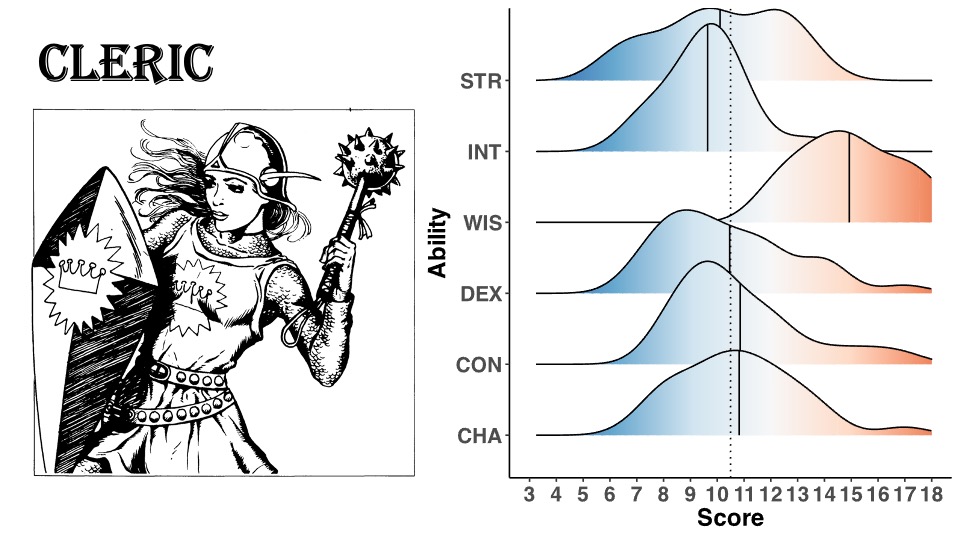
I have been ruminating about old school D&D Ability Scores, and whether they meant all that much. So I decided to run the numbers. I entered 146 pregenerated character stat lines found in the B series of adventure modules into a spreadsheet and imported them into R Studio. Pooped out some descriptives and ridgeline plots, and here is the result. It's more of a descriptive analysis than an inferential one - I do plenty of the latter in my day job.
 
Keep in mind that I can only look at what the designers chose for their Basic modules. I was active in the 80s and the actual state of play was all over the place. Overpowered characters with ludicrously high scores were ever-present. I propose that the more restrained arrays in the modules are reflective of designer intent, whatever you believe that is worth.

What I wanted to find out:
  • How did the carefully pregenerated module characters stack up to 3d6 down the line?
  • What would an average representative of a Basic D&D Class look like score-wise?

Overall Ability Scores by Class

Ideally, Character creation in Basic D&D involves rolling up a set of six Ability scores from 3-18 each, then seeing what sort of Class they qualify for. A Magic-user needs an INT higher than 9, etc. This first plot is the average Ability score for a given class, lumped together. This gives a broad overview of what the actual average score is and which classes tend to get assigned better rolls. At this point there were no Ability score bonuses for Races, so everything is conveniently 3-18.
 
To show this I use ridgeline plots, a kind of smoothed aesthetically-pleasing histogram. I have added a dotted vertical line in the middle of each to show the mean (10.5) for a 3d6 roll. The color also shifts with the score - lower scores are bluish, higher scores reddish.


Well, would you look at that - an awfully suspicious trend towards better-than-average! Is this a selection bias to ensure that players get decent pregens, or a result of Moldvay's option to reroll "hopeless" characters? 
 
The world may never know. 
 
The average module pregen actually sits at 11.4, or roughly 11-12. This is a slight boost over the 10-11 expected with purist 3d6 rolls. Sorry, but I can't be bothered to check for statistical significance, even with R open as I am writing. Maybe later.

Other take-aways:
  • Clerics and Thieves seem to get assigned the worst overall rolls.
  • Elves and Dwarves seem to get assigned the best overall rolls. 
  • Magic-users and Dwarves seem to occupy more of the very high results, shown by the taller and longer red tails.
  • Halflings have a weird small bump in the low/blue end, perhaps a population of crappy Halflings that throw their otherwise good curve off.
  • Fighters are very consistent, almost a normal curve for their rolls.

Classes Breakdown

What follows is a little different: the average score for each individual ability, separated by Class. This shows what specific ability scores are favored or disfavored when considering a Class. Sometimes, the histogram splits into two peaks, and it is debatable what that means.
 
To preface some things I will mention later, Basic D&D also had a thing called a Prime Requisite, which is an Ability Score or two that the designers deemed important for that Class. If they were good (13+) you would get a bonus to earned XP. If they were bad, you could get a hefty penalty to XP. I believe these explain most of the patterns you see below.
 
(Images by Terry Dykstra, from the Rules Cyclopedia)


Middling folks relying on their connection to a (usually) unspecified deity! Rolled arrays with a high WIS and little else going for them seem to become Clerics. WIS is entirely for the Prime Requisite XP bonus I think. It only enhances magic saves, which everyone else needs just as much. Clerics tend toward lower INT, probably because religion is silly. To be fair though, the power and versatility of their Class more than makes up for the quality of its members.

The module authors are really giving some good scores to Dwarves. STR and CON are reliably huge. INT, CHA, and DEX tend to suffer, but the two peaks suggest two different camps on whether their WIS and CHA should be high or low. The stereotypes weren't quite set in stone then perhaps.
 
As a special note, see the low blue tail on CON that shouldn't be there. This is partly the ridgeline smoothing extending the curve, but also some mistaken roll assignments. Dwarves have a minimum CON of 9, but tell that to the module authors. This happens elsewhere too (see Halflings).

The best scores reliably go to Jacked-Genius Elves. If you get an array that could make one, I guess you just go for for it. The peaks might show a little division on whether their CON and WIS scores should be low or high.

Halflings were oddly beefy for their size, which no one seemed to think twice about. Despite basically being Fighters, they had minimums and prime requisites that meant the best scores would often go to them. This was probably intended to keep them rare, like elves, but also just made most adventuring exemplars of their race pretty outstanding.


As Ash Williams might say: "Hit first, Think never." Good physical scores and low mental ones. There is a broader range of CHA - a high one makes sense if you want them to be a good leader at domain level, a low one if they are just a rough-neckin' thug.


Scraggly nerds, but they are investments for later godliness, so you want to give them a solid set of scores. A high INT and low STR is obvious, everything else is a nudge above average. Note that like the Cleric, their prime requisite of INT is only good for the XP Bonus.

Light-fingered and charming, with little else going for them. Most of the time they will be relying on their special abilities rather than their Scores anyway - and even their godly DEX has no effect on these in Basic.

Summary of Breakdowns

So if you just "need a guy" real quick, you won't be too bad off using one of these arrays:


A Word on Prime Requisites

The idea of high Ability Scores primarily just giving an XP bonus to certain Classes may seem strange to a modern player. This is often its largest benefit in B/X. For example, the benefit of having a higher INT is mostly that your Magic-user rises through their levels a bit more quickly. It has no direct effect on their number of spells or spells known. It only has an impact on their magic in a roundabout way, unlike later editions.

A Word on Minimums

Most Classes also had minimum scores, but those probably had less influence. There are even errors there, for example some Halfling pregens had CON scores below 9! I have left similar genuine mistakes in the database uncorrected, only correcting obvious typos like a Fighter with a CON of 1. In that case I changed it to an 11 - "1" is a common typo for a repeating number like 11 and close to the average anyway.

Conclusion

I don't think anyone came away from this with any surprises. Pregenerated characters had slightly higher Ability Scores than 3d6 down-the-line would imply, Ability Scores tended to reflect the Prime Requisite(s) of the Class, Clerics blow, and Elves rule. I had fun doing it though and hope you got something out of it too, even if it was just confirming your suspicions.

Comment below, especially if there is something else you want to look at.

Saturday, February 24, 2024

Preserving the Mundane Peril of Dungeons at Higher Levels

Lower level parties sally forth to the dungeon with a healthy concern for logistics - food, shelter, water, light, etc. Failing to stock up can mean their doom. Later, advanced magic easily makes up for a lack of preparation - or is outright superior! This can make for an unwelcome switch in play style for those who enjoyed the tension of their earlier forays. 

In most dungeon games this change in play style is inevitable. Like it or not, it is part of the experience. It allows the party to take on a grander scale of adventure after proving themselves in the muck. Still, it feels like a sad error to abandon the grim lessons of earlier adventures entirely. Players who took these  to heart do not want to see them drift into obsolescence. Those who did not may fail to even respect the threat of the dungeon.

To this point, I have assembled some methods to keep dungeons dangerous. The point here is not to turn a dungeon into the Tomb of Horrors but to show how a dungeon can be drawn up in a way that preserves its aura of mundane peril despite level.

Silent But Deadly

The flame of torches and lanterns can reveal deadly oxygen-displacing gases. Make their light flicker  when they get close to an otherwise undetectable pool of suffocating or poisonous gas. Have it snuff out when they would need to make saves. Infravision and light spells have no flame to reveal this, so parties reliant on such powers find themselves doomed by their own superiority.

Obviously, this gets tricky if the pool of gas happens to be flammable. Consider that it is still better to find that out at its edge rather than while casting a fire spell within it later. A torch or lantern that merely bursts or changes color near a concentration of flammable gas can be a lifesaver for an observant party.

Lurkers in the Darkness

It is dark. You have been eaten by a grue. An antidote to all the fancy races with dark vision and their annoying players who have to tell you about it every time. Sure, they can see the grue, but will wish they hadn’t. A hazard easily fixed by a torch or lantern, but also amenable to light spells. Bold and greedy merchants in town could mark up their torches and advertise them as “grue repellent.”

This doesn't need to be as exotic as a grue. Animals and primitive monsters may be repelled by fire itself, to the point they avoid parties carrying open flame. This is not so easily outclassed by light spells.


The Tight Squeeze

They call it a dungeon crawl, so why aren't they crawling? Heavy armor and huge weapons are great until you have to squeeze through a tiny cave tunnel. Then, it is time for the lowly, skinny, flexible goblin to shine. A party that would beat the gods themselves on the field of battle is just a wiggly, screaming meal when pinned between two solid stone cave surfaces. 

Just getting stuck may arguably be just as bad - the recent Nutty Putty cave incident being an example. This awful fate should bring a little tremor to the heart of the bravest adventurer, and at the very least make them consider hiring a local guide to keep them out of the worst passages.

This is an unglamorous way to go and it makes sense to give warnings. The tooth-marked skeletons of an early party, trapped in their rusting armor should do. I'm sure you can think of something better.

Spells like passwall and stone to mud, divination, etc. can avoid this, but this is at least a cost.

Perils to Avoid

There's a fine line here in that if you overdo these techniques it may ruin the feeling of immersion and fairness. Plan these out beforehand instead of adding them on the fly. Make them a real part of the world. Otherwise, the players may feel that you are just placing arbitrary obstacles in their way, and they will have a good point. 
 
Give them ample warnings, and use the carrot instead of the stick: show that the more earthly methods of dealing with dungeon danger still have their advantages.
 
Got your own special methods? Tell us about them below!

Saturday, February 17, 2024

A Modest Procedure


Image by StockSnap from Pixabay  

Seeing all the discourse about how games do not support something if they do not have rules for it, I had a revelation. There is a glaring omission - no games support the veritable act of gaming itself! Therefore, no games actually support the gaming experience and the entire holy mission of role-playing games is a failure. 

So sad!

But, there is a cure - simply close the loop and use the system itself. When you are thinking of running a game, just roll:

For D&D-alikes

  • Critical Success: You played the best game and everyone cheered at the end.
  • Success: You had a good session and your players want more.
  • Failure: You had a frustrating session full of boredom and arguments.
  • Critical Failure: You had the worst session ever and everyone quit.

For PBTAs:

Run the Game: think about your players and roll+run. 

  • On a 10+ you had a good game. 
  • On a 7-10 you had a good game but payed so dearly for it you wish you hadn't even tried. 
  • On a miss (6-), you had a terrible game and look stupid.

Best part is the experience of gaming is so well supported it elides every inconvenience!

Thursday, February 1, 2024

SHQUART CHART

 Presented with little fanfare, and largely self-explanatory.


Hopefully, this helps someone.

MUTANANNY Post Mortem

  This is one of those posts that no one really plans to make. I'm going to discuss two points of failure: first the crowdfund and then ...